“With the Vectis, welding is
no longer our bottleneck.”
Jim H. (Owner, H&H Metals)
Cobot welding & cutting, built by the industry pioneers.
Boosting your productivity with approachable, affordable automation.
More than 800 successful deployments across North America, ranging from small job shops to Fortune 50 companies.
Increased Productivity Now
On average, manufacturers see a 3-4x productivity boost with Vectis, with less waiting — typical lead time is a few weeks.
No experience required to get your first welds running in minutes. Leverage advanced features to grow in the future.
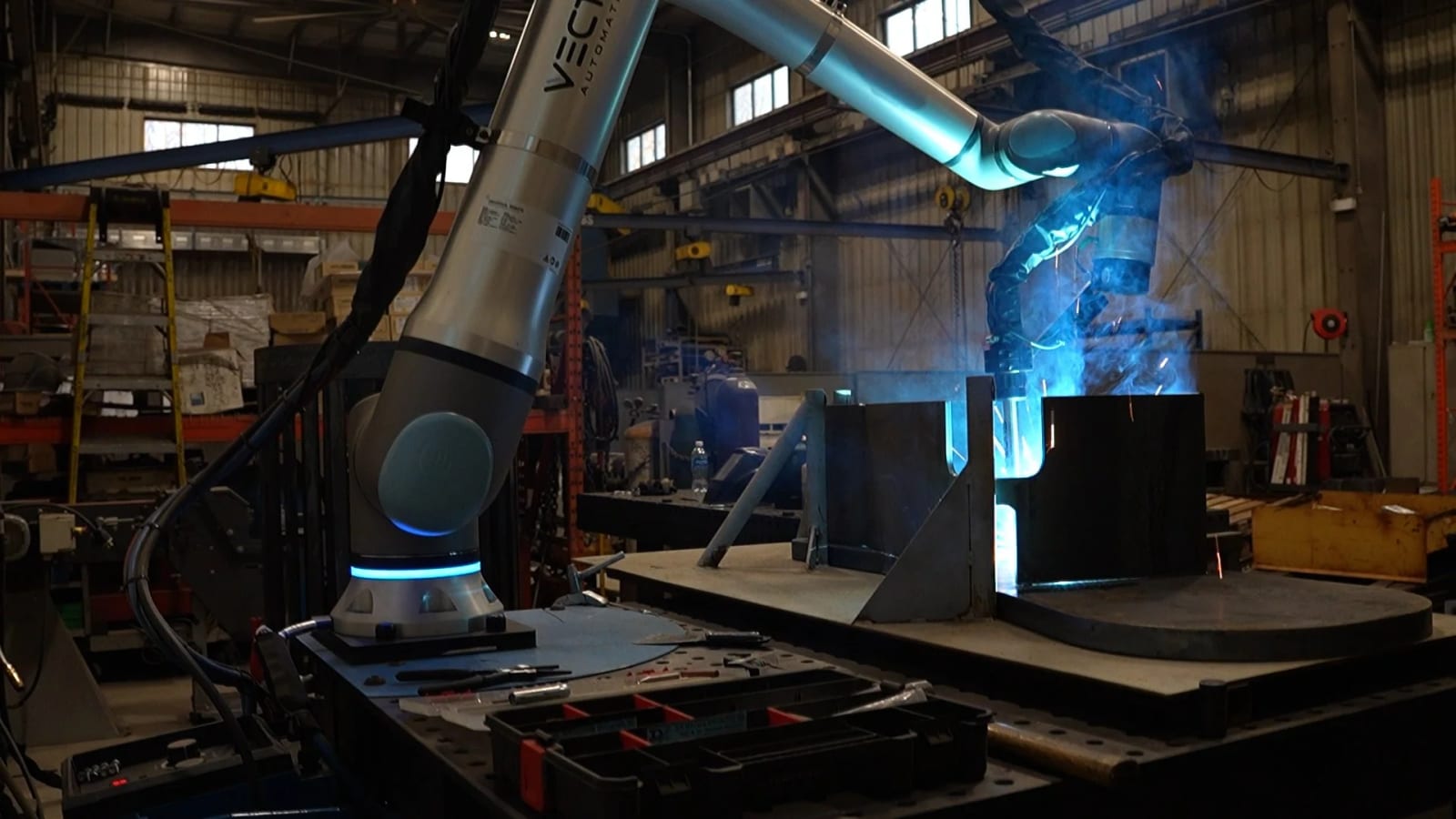
Compact, mobile deployment options enable unmatched flexibility — bring the part to the cobot, or the cobot to the part.
Support from Dedicated Experts
Complimentary application evaluations, knowledge from 300+ years combined experience, and no subscription fees.
Powerful, Robust Features
Highest functionality system on the market, utilizing advanced Vectis software and industry-leading Universal Robots arms.
Automation that scales to your business.
Trusted by small job shops and Fortune 500 enterprises alike...
…and hundreds more shops just like yours.
Supported by a team that understands your industry.
Vectis Cobot Welding & Cutting Tools
Cobot Welding Success starts with:
Right Application & Right Champion
With over three centuries of combined experience in the robot & cobot welding industry, we know what makes automation actually work in production.
Our mission is not to just sell you a cobot welding or cutting system. Our mission is to provide you with a practical solution to increase your fabrication capacity, quality, and stability. A key part of the Vectis process is collaboratively reviewing your application to provide insight on application viability and how to achieve success in production. We will always give you an honest answer.
Cobot Welding & Cutting FAQ
What is a welding cobot? A collaborative robot, or “cobot”, is a unique type of six-axis robot that can work alongside humans and is often very easy to program. It is able to work alongside humans via force-torque sensors that protect the operator from harm.
A collaborative robot, or “cobot”, is a unique type of six-axis robot that can work alongside humans and is often very easy to program. It is able to work alongside humans via force-torque sensors that protect the operator from harm.
How much does a cobot welder cost? The majority of our systems cost $95k-$140k all-in; depending on configuration. This includes full plug-n-produce integration, shipping, 2yr warranty, lifetime software license, and our unprecedented 30-day return policy. Oftentimes customers find our prices to be 25-40% less than traditional robot cells and other competitors. You can view our pricing spectrum by clicking here; or request a formal quote here
How much does a cobot welder cost?
The majority of our systems cost $95k-$140k all-in; depending on configuration. This includes full plug-n-produce integration, shipping, 2yr warranty, lifetime software license, and our unprecedented 30-day return policy. Oftentimes customers find our prices to be 25-40% less than traditional robot cells and other competitors. You can view our pricing spectrum by clicking here; or request a formal quote here
What kind of tangible ROI does a cobot welding tool typically provide? Most of our customers report a payback of 2 years or less; through a typical weld batch productivity boost of 3-4x. This results in a weld labor savings of 3-4x per batch of parts. There are numerous other benefits as well - including talent attraction/retention, higher quality, less grinding, offloading the boring arc-on time so your skilled welders can focus on higher-skill tasks, and increased capacity to take on new business!
What kind of tangible ROI does a cobot welding tool typically provide?
Most of our customers report a payback of 2 years or less; through a typical weld batch productivity boost of 3-4x. This results in a weld labor savings of 3-4x per batch of parts. There are numerous other benefits as well - including talent attraction/retention, higher quality, less grinding, offloading the boring arc-on time so your skilled welders can focus on higher-skill tasks, and increased capacity to take on new business!
What are some of the intangible ROI factors? We’ve been asked how to calculate these intangibles; which ends up being very dependent on your specific scenario and pain points. Here are some points we’ve heard from existing customers:Reduced rework/scrap due to poor-quality manual welds (or missed welds): Look at COPQ metrics – rework, scrap rate, field failure rate, etc to see if some could be solved through improving quality of welds Reduced training time for new welders – operating the cobot doesn’t require the same dexterity/experience as manual welding, so the learning curve is much quicker. Look at training cost and turnover cost metrics Talent attraction & retention tool. Look at cost of recruitment, and opportunity cost of not having enough welders on-hand to meet current demand (if this is a challenge you currently face – many of our customers state this is the #1 reason to automate – meet current/future demand). Reducing grinding/clean-up time (sometimes even eliminated). This can sometimes be an even greater financial and EHS impact than the weld labor savings. To calculate, look at amount of grinding/clean-up time related to the applications you’re looking to cobotically weld. Conservatively reduce it by 50%; or 100% (eliminate) if you want to be aggressive. Ability to bring in new business due to increased capacity. Look at “opportunity cost” – “if we had Xhrs more welding capacity, how much more revenue would that allow us to generate?”, with the Xhrs provided by the increased productivity of the cobot
What are some of the intangible ROI factors?
We’ve been asked how to calculate these intangibles; which ends up being very dependent on your specific scenario and pain points. Here are some points we’ve heard from existing customers:
Reduced rework/scrap due to poor-quality manual welds (or missed welds): Look at COPQ metrics – rework, scrap rate, field failure rate, etc to see if some could be solved through improving quality of welds
Reduced training time for new welders – operating the cobot doesn’t require the same dexterity/experience as manual welding, so the learning curve is much quicker. Look at training cost and turnover cost metrics
Talent attraction & retention tool. Look at cost of recruitment, and opportunity cost of not having enough welders on-hand to meet current demand (if this is a challenge you currently face – many of our customers state this is the #1 reason to automate – meet current/future demand).
Reducing grinding/clean-up time (sometimes even eliminated). This can sometimes be an even greater financial and EHS impact than the weld labor savings. To calculate, look at amount of grinding/clean-up time related to the applications you’re looking to cobotically weld. Conservatively reduce it by 50%; or 100% (eliminate) if you want to be aggressive.
Ability to bring in new business due to increased capacity. Look at “opportunity cost” – “if we had Xhrs more welding capacity, how much more revenue would that allow us to generate?”, with the Xhrs provided by the increased productivity of the cobot
What are the common problems / struggles of robotic welding applications? The most common challenges we see are A) poor consistency caused by upstream equipment and/or fixturing; B) trying to bite off too much in the first stages - it’s important to crawl/walk before you run! and C) lack of champion/ownership. We address these challenges & how to conquer them in further depth in our Keys to Success. As well, our cobot welding experts are here to guide you through these challenges for your specific applications - reach out to us today to start the conversation!
What are the common problems / struggles of robotic welding applications?
The most common challenges we see are A) poor consistency caused by upstream equipment and/or fixturing; B) trying to bite off too much in the first stages - it’s important to crawl/walk before you run! and C) lack of champion/ownership. We address these challenges & how to conquer them in further depth in our Keys to Success. As well, our cobot welding experts are here to guide you through these challenges for your specific applications - reach out to us today to start the conversation!
Is cobot welding & cobot cutting a proven technology? Yes! We have over 800 Vectis systems in the field; welding & cutting day-in and day-out. As well, our cobot arms we use from Universal Robots have been deployed in over 100,000 applications worldwide.
Is cobot welding & cobot cutting a proven technology?
Yes! We have over 800 Vectis systems in the field; welding & cutting day-in and day-out. As well, our cobot arms we use from Universal Robots have been deployed in over 100,000 applications worldwide.
Are welding cobots accurate? Are cobot welds high-quality? Yes & yes, so long as the parts fed to the cobot are consistent! The Universal Robots arms we integrate into our welding & cutting systems have a positional repeatability of ± 0.1 mm (~0.004”) with payload per ISO 9283. The primary factor to accurate welds is the consistency of the parts and the fixturing; which we can help you with.If the parts are consistent, you can make some absolutely beautiful welds that pass inspection with flying colors. Check out some of the welds customers have made with the Vectis by clicking here to head to our gallery
Are welding cobots accurate? Are cobot welds high-quality?
Yes & yes, so long as the parts fed to the cobot are consistent! The Universal Robots arms we integrate into our welding & cutting systems have a positional repeatability of ± 0.1 mm (~0.004”) with payload per ISO 9283. The primary factor to accurate welds is the consistency of the parts and the fixturing; which we can help you with.
If the parts are consistent, you can make some absolutely beautiful welds that pass inspection with flying colors. Check out some of the welds customers have made with the Vectis by clicking here to head to our gallery
Are cobots taking jobs? Quite the opposite! The overwhelming majority of our customers report an expansion of their welding operation due to the increased capacity cobots provide their weld shop.Even more excitingly, cobots still need human Champions! The cobot allows fabricators to offload the boring arc-on time to the cobot; allowing your team members to both Upskill & Focus-Skill on other, more interesting tasks!
Quite the opposite! The overwhelming majority of our customers report an expansion of their welding operation due to the increased capacity cobots provide their weld shop.
Even more excitingly, cobots still need human Champions! The cobot allows fabricators to offload the boring arc-on time to the cobot; allowing your team members to both Upskill & Focus-Skill on other, more interesting tasks!
How fast are cobots? How fast can cobots weld? Cobots can weld as fast as the material & welding process allow. For a common 1/4” mild steel fillet; this could be in the realm of 18-25ipm weld travel speed depending on material quality & joint consistency. There are certainly welds that run slower (larger and/or gap-prone); and ones that run faster (we have a customer running 93ipm on thin aluminum!).Since the weld travel speed is largely dictated by the material & process (regardless of who/what is holding the torch); the cobot’s typical 3-4x productivity boost is largely provided by its increased arc-on time relative to manual welding.
How fast are cobots? How fast can cobots weld?
Cobots can weld as fast as the material & welding process allow. For a common 1/4” mild steel fillet; this could be in the realm of 18-25ipm weld travel speed depending on material quality & joint consistency. There are certainly welds that run slower (larger and/or gap-prone); and ones that run faster (we have a customer running 93ipm on thin aluminum!).
Since the weld travel speed is largely dictated by the material & process (regardless of who/what is holding the torch); the cobot’s typical 3-4x productivity boost is largely provided by its increased arc-on time relative to manual welding.
What batch sizes are needed to justify cobot welding? Most customers are finding economic returns with batch sizes between 20 — 1,500. However, there are plenty of outliers on both sides. Some customers are finding economic returns programming one-offs based on quality improvements. Others are welding thousands of parts and enjoying the ease-of-programming, smaller footprint, and collaborative flexibility.
What batch sizes are needed to justify cobot welding?
Most customers are finding economic returns with batch sizes between 20 — 1,500. However, there are plenty of outliers on both sides. Some customers are finding economic returns programming one-offs based on quality improvements. Others are welding thousands of parts and enjoying the ease-of-programming, smaller footprint, and collaborative flexibility.
What materials can Vectis cobots weld? Can cobots weld aluminum? Our cobot tools can weld a broad variety of materials - carbon steel, stainless, steel, aluminum, and exotic metals (Inconel, Hastelloy, Monel, etc)Aluminum is most often welded with our Push-Pull wirefeeding configuration to manage the relative low-columnar-strength of aluminum MIG wire. We recommend this push-pull configuration when welding aluminum wire 3/64” (0.047”) diameter or smaller; and for all sizes of 4XXX series wire.
What materials can Vectis cobots weld? Can cobots weld aluminum?
Our cobot tools can weld a broad variety of materials - carbon steel, stainless, steel, aluminum, and exotic metals (Inconel, Hastelloy, Monel, etc)
Aluminum is most often welded with our Push-Pull wirefeeding configuration to manage the relative low-columnar-strength of aluminum MIG wire. We recommend this push-pull configuration when welding aluminum wire 3/64” (0.047”) diameter or smaller; and for all sizes of 4XXX series wire.
官网:https://vectisautomation.com/
资料来源:企业官网公司简介(复核日期:2026-10-07)。